Getting the most out of a robot by choosing the right tactile sensor
For: Companies and system integrators bringing tactile sensing to robots
The problem
For a robot to handle contact-rich work reliably — inserting a connector, gripping something deformable, assembling parts — appropriate tactile sensing is essential. Meanwhile the tactile sensor market is diversifying quickly, and products differ in operating principle, characteristics and cost. That widening range of options is itself what makes adoption hard.
-
No way to tell which one suits your task
Each sensor differs in the tasks it is good at, the physical quantities it can measure and its price range. Picking the right one for your task means understanding both the characteristics of each sensor and the conditions on your floor — a judgement that is hard to make without specialist knowledge.
-
You cannot tell whether it fits until you try it
How well a sensor fits only becomes visible once it is running on the actual task. But assembling evaluation hardware, wiring it up and testing it is itself costly, so teams are forced to bet on one candidate before they can compare several. The result is that a mis-selection is often only discovered when a proof of concept stalls.
-
Even once you have chosen, integration drains the effort
Once a sensor is chosen, connecting it to the robot control system, synchronising it and calibrating it tend to be one-off work, taking more engineering hours than expected.
What follows is that teams who want to add touch, but do not know where to start, either never commit to adoption or abandon it partway.
Our approach
Which tactile information do you actually need, and which product can genuinely capture it? commissure is in a position to answer both, and we take on the adoption decision itself.
-
Deciding what information is needed, from research into touch
What do people rely on when they make contact? We use that research as the axis for selection, narrowing the diverse market down by asking what tactile information the task truly requires.
-
Judging fit from hands-on evaluation
Datasheet specifications alone do not tell you what a sensor is good and bad at. From the experience of actually running sensors and data collection devices from many makers, we judge fit for the intended use before adoption — so that you do not find out only after trying.
-
Making integration lighter with middleware
We connect the selected sensor to the robot control system through our middleware, HaptoConnect. Connection and synchronisation, which otherwise tend to be handled sensor by sensor, are made common, holding down the effort of wiring things together.
We can evaluate other makers’ products from the position of developing tactile sensors ourselves, and we can bring research into human touch to the selection. That is what sets this apart from a general-purpose integrator.
What we expect
Sensing that fits your site
Working back from the task, the cost and the conditions on the floor should get you closer to tactile sensing suited to your site than a generic configuration would.
Lower risk of a failed rollout
Judging fit at the selection stage should reduce the risk of installing a sensor that does not suit the task.
Less time to deployment
Connecting through middleware should shorten the time integration takes.
Products used
-
HaptoConnect
Middleware that connects a wide range of tactile sensors to robot learning pipelines. It unifies the data formats and time synchronisation that differ from sensor to sensor, supporting the path from plugging a sensor in to starting imitation learning with touch.
Projects
-
Tactile Arena
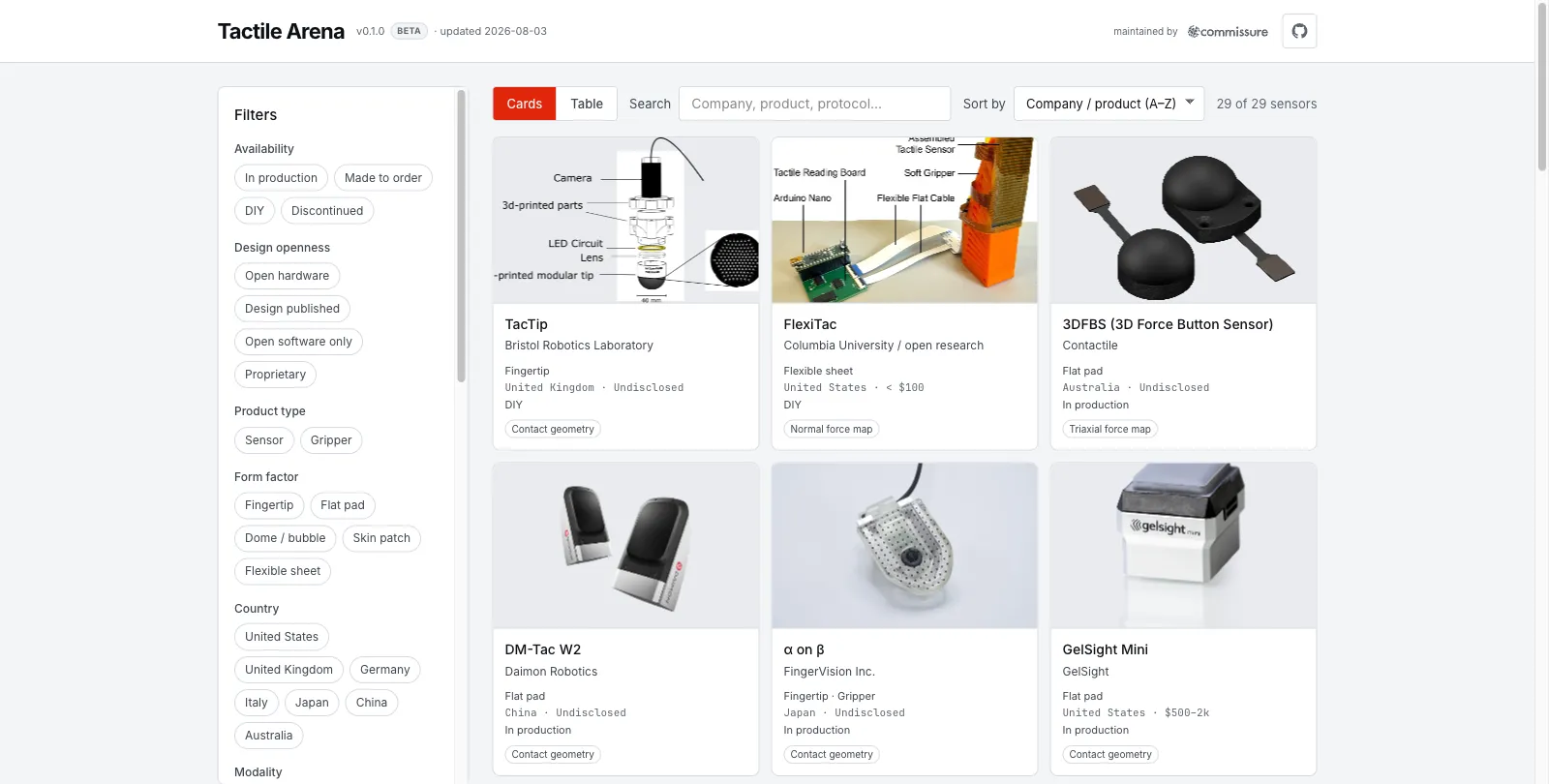
commissure publishes Tactile Arena, an open catalogue for comparing tactile sensors for robots side by side. Operating principle, the physical quantities a sensor measures, its characteristics and its price range are laid out in a common format, so that a wide variety of tactile sensors can be evaluated and compared against each other.
- Related material